Some of the most important advancements in modern fabrication aren’t immediately visible when you walk through a manufacturing facility. The laser table, press brakes, welding equipment, cranes, and finished assemblies may attract the most attention, but increasingly, a significant amount of fabrication work is happening before material ever reaches a machine.
Digital modelling, offline programming, and advanced manufacturing software have changed how fabrication teams prepare for production. Instead of waiting until material reaches the shop floor to work through every detail of a component, many decisions can now be evaluated digitally. Bend sequences can be planned, cutting layouts can be optimized, potential conflicts can be identified, and production requirements can be considered earlier in the process.
The objective isn’t to remove human decision making from fabrication. In many ways, it’s the opposite. Digital tools give experienced tradespeople and production teams more information earlier, allowing their knowledge to be applied before a potential issue becomes a physical problem. As industrial equipment becomes larger, more complex, and subject to increasingly demanding tolerances and schedules, that ability to plan ahead has become an important part of modern fabrication.
More of the Fabrication Process Is Happening Before Production
Traditionally, many fabrication decisions were worked through directly on the shop floor. Experienced fabricators would interpret drawings, determine how components should be produced, make adjustments during fit up, and use their knowledge of material behaviour to work through challenges as they appeared. That experience remains essential, but modern technology allows more of those decisions to be considered before production begins.
Digital models provide another way to understand how individual components relate to a complete assembly. Offline programming allows machine operations to be prepared without occupying production equipment, while manufacturing software can help determine cutting arrangements, forming sequences, and other production requirements before material is processed.
This becomes particularly valuable when fabricating complex industrial equipment consisting of many individual components. A change to one part can influence another stage of production, and decisions made during cutting or forming can ultimately affect fit up, welding, assembly, and final dimensional accuracy. Evaluating those relationships earlier gives fabrication teams an opportunity to identify potential challenges while changes can still be made efficiently.
Digital planning also supports repeatability. When programs and processes are developed before production, they can be applied consistently across multiple components rather than requiring the same decisions to be made independently each time. For projects involving repeated parts or assemblies, that consistency can contribute to both efficiency and quality.
Better Information Helps Reduce Rework
Rework is rarely caused by one dramatic mistake. More often, it results from a series of smaller issues that become apparent as a project progresses; a bend sequence may create an access problem for a later operation, a component may technically match the drawing but be difficult to manufacture efficiently, material utilization may be improved by changing a cutting layout, an assembly sequence may reveal that certain components need to be produced or installed before others.
Digital tools allow many of these considerations to be explored before steel is cut.
That doesn’t mean software can predict every challenge that will occur during fabrication. Material behaviour, welding distortion, equipment limitations, tolerances, and the realities of assembling large fabricated structures still require practical knowledge and judgement. What technology can do is provide better information earlier, giving experienced people another opportunity to recognize potential problems and determine the best path forward.
Identifying an issue digitally is generally preferable to discovering it after a component has already been cut, formed, welded, or incorporated into a larger assembly. Earlier decisions can help reduce unnecessary material use, avoid repeated operations, support more predictable production schedules, and create a smoother path through subsequent stages of fabrication.
“The real advantage of digital manufacturing isn’t removing decisions from the shop floor. It’s giving experienced people better information before those decisions have to be made.”
Technology Works Best When Experience Guides It
As manufacturing technology continues to advance, it can be tempting to view automation and software as replacements for traditional fabrication knowledge. In practice, the two are most effective when they work together.
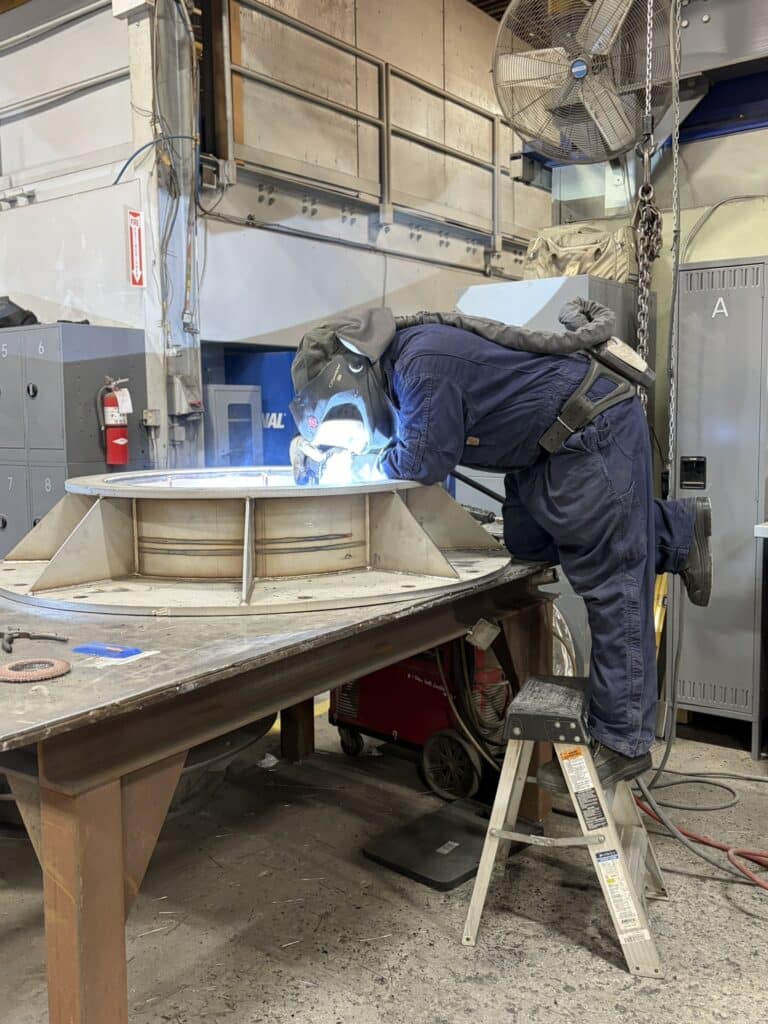
Software can calculate, simulate, organize, and repeat with impressive consistency. It cannot replace the practical understanding developed by someone who has spent years working with stainless steel and specialty materials. Experienced tradespeople understand how materials behave during forming, where welding distortion may occur, when a sequence may create difficulties later in assembly, and when something that appears straightforward on a screen may be considerably more complicated in the shop.
That relationship between technology and experience is becoming increasingly important as fabrication facilities invest in more advanced equipment. CNC machinery, automated material handling, digital models, and offline programming can improve efficiency and consistency, but their value ultimately depends on how effectively they are incorporated into the broader manufacturing process.
At D&R Custom Steel, technology is an important part of how fabrication continues to evolve. Digital tools and modern equipment provide new ways to plan and execute complex work, while the knowledge of experienced project managers, fabricators, welders, and other skilled tradespeople provides the judgement required to use those tools effectively. Modern fabrication isn’t becoming less dependent on people as technology advances. Instead, technology is giving skilled people increasingly powerful tools to plan earlier, work more efficiently, and make better informed decisions throughout production. The equipment on the shop floor may be the most visible sign of manufacturing technology, but some of its greatest value can be found in the work completed before fabrication ever begins.