When people see a piece of industrial equipment arriving at a job site, it’s easy to assume the hardest part is over. In reality, successfully shipping large fabricated equipment is the result of weeks (or sometimes months) of planning that begins long before the first truck arrives at the fabrication shop. For oversized stainless steel equipment such as clarifiers, digesters, rotary distributors, tanks, and travelling water screens, transportation is not simply the final step in a project. It is an important consideration throughout the entire fabrication process.
From the earliest stages of production, fabrication teams must think beyond the shop floor. How will the equipment be transported? Will it require multiple truckloads? Can it safely travel within highway regulations? Will it arrive at the site in the correct sequence for installation? These questions all influence how equipment is designed for fabrication, assembled, and prepared for shipment.
Shipping Starts Long Before Fabrication Is Complete
For large scale fabricated equipment, transportation planning begins well before final assembly.
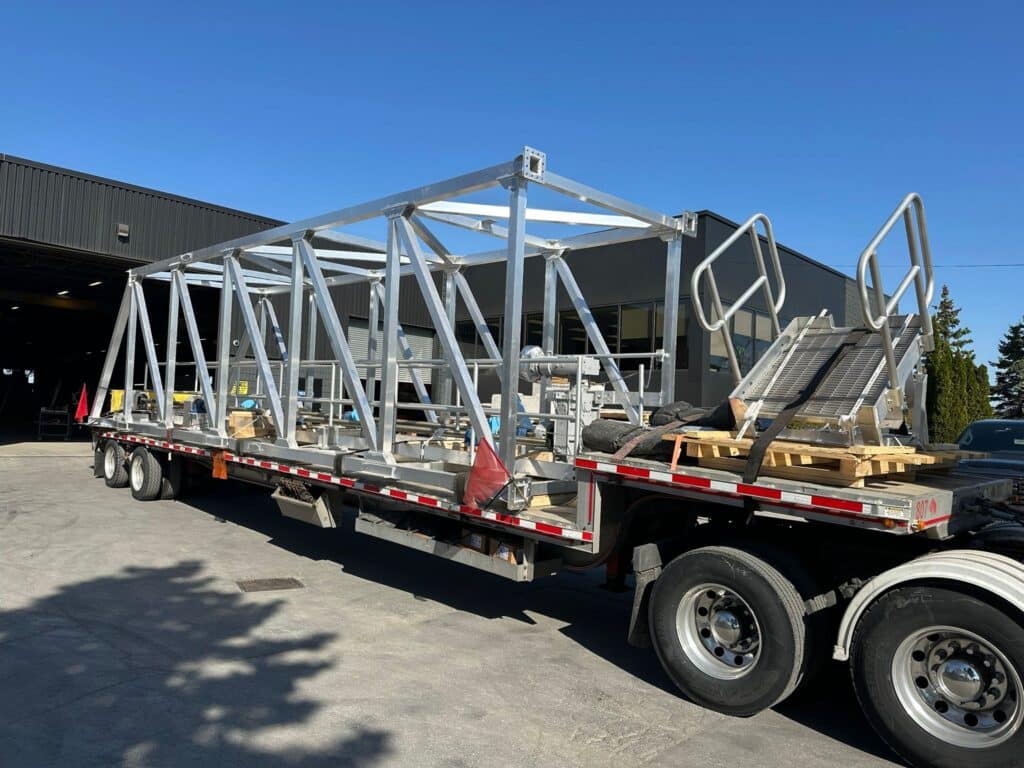
Project teams work closely with customers to understand site conditions, transportation requirements, lifting limitations, and installation sequencing. In many cases, equipment is intentionally fabricated in sections that can be safely transported and efficiently reassembled once delivered to the project site. The goal is to balance fabrication efficiency with practical transportation requirements while maintaining the structural integrity and performance of the finished equipment.
Throughout fabrication, dimensions are continually verified to ensure components will not only fit together correctly but will also comply with transportation limitations where applicable. Careful planning at this stage helps reduce unexpected delays and allows fabrication, logistics, and installation activities to work together as one coordinated process. Rather than viewing shipping as something that happens after fabrication, experienced manufacturers consider logistics as an integral part of the project from the very beginning.
Preparing Equipment for the Journey
Before equipment leaves the fabrication facility, every shipment must be carefully prepared to protect both the equipment and the project schedule. Depending on the project, fabricated components may undergo final inspections, trial assemblies, hydrostatic testing, or Factory Acceptance Testing (FAT) before being prepared for transport. Once approved, equipment is securely packaged using methods appropriate for the project requirements, including custom supports, protective coverings, shrink wrapping when specified, and shipping configurations designed to minimize movement during transit.
Loading itself is also carefully planned. Weight distribution, lifting points, transport orientation, and sequencing all play an important role in ensuring equipment can be safely loaded, transported, and unloaded at its destination. For larger projects involving multiple truckloads, shipment sequencing is equally important so that components arrive in an order that supports efficient field assembly.
Each of these steps helps reduce the risk of damage, protects fabrication quality, and contributes to a smoother installation once the equipment reaches the customer.
“Successful shipping isn’t determined when the truck arrives. It’s determined by the planning that began months before the equipment ever left the shop.”
Logistics Are Part of Quality
Quality fabrication extends beyond welding, machining, and inspection. It also includes ensuring equipment arrives at its destination in the same condition it left the fabrication facility. For industrial projects, delays caused by damaged equipment, incomplete shipments, or inefficient delivery sequencing can impact construction schedules, installation crews, and commissioning activities. Effective logistics planning helps minimize these risks while supporting a smoother transition from fabrication to field installation.
At D&R Custom Steel, many of the projects we fabricate travel hundreds, or even thousands, of kilometres before reaching their final destination. Whether equipment is shipping across Ontario or to project sites throughout North America, careful coordination between fabrication, project management, inspection, and logistics helps ensure every shipment is prepared with the same attention to detail that goes into building it.
In industrial fabrication, shipping is much more than transportation. It’s the final stage of manufacturing, and an important part of delivering a successful project.