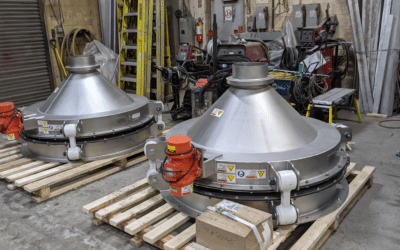
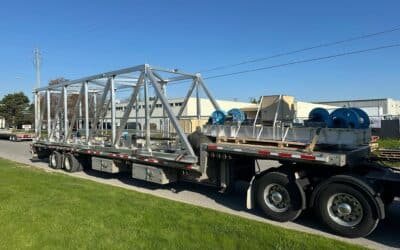
When people see large industrial equipment arriving at a project site, it’s easy to assume the fabrication work is complete. The equipment has been built, inspected, loaded onto trucks, and delivered. The next step is simply: installation. In reality, some of the most important work happens before that equipment ever leaves the fabrication facility.
For large fabricated equipment such as clarifiers, travelling bridges, rotary distributors, digesters, and other process equipment, successful installation often depends on planning and verification completed weeks before shipment. One of the most valuable tools in that process is the trial fit. While not every project requires one, trial fits have become an important part of many complex fabrication projects where dimensional accuracy, alignment, and assembly are critical. They provide an opportunity to verify that major components fit together as intended before the equipment is disassembled, loaded onto trucks, and shipped to its final destination.
For owners, engineers, contractors, and municipalities, that additional verification can provide confidence that the equipment arriving on site has already been assembled and evaluated under controlled conditions.
Building It Once Is Good. Proving It Fits Is Better.
Large industrial equipment is rarely shipped as one complete assembly. Transportation regulations, lifting capacities, bridge clearances, and overall project logistics often require equipment to be fabricated in multiple sections before being transported to the project site for final installation. While this approach makes transportation possible, it also introduces another challenge: ensuring every individual component fits together exactly as intended once it reaches its destination.
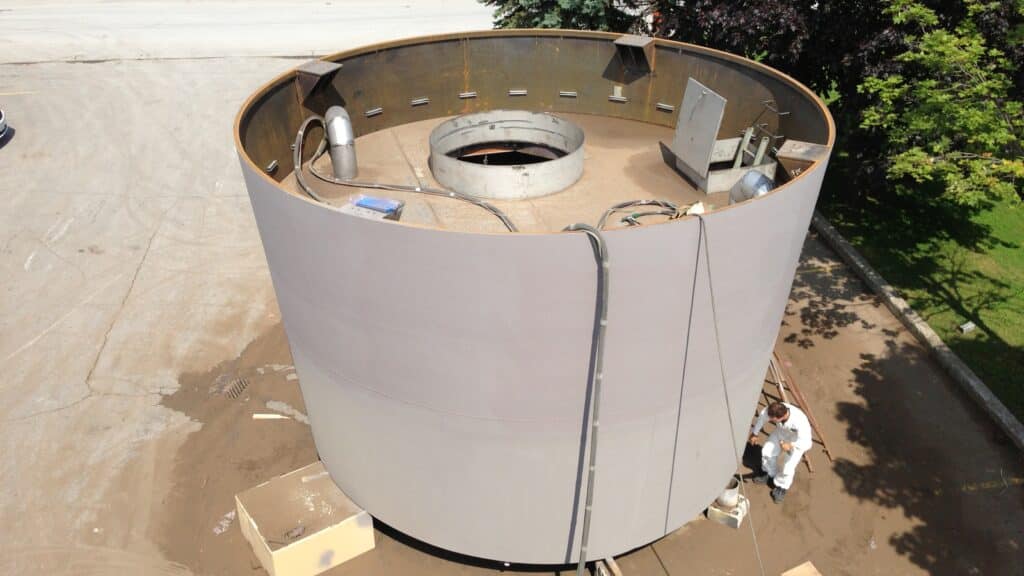
That is where trial fits become invaluable. During a trial fit, fabricated components are temporarily assembled inside the fabrication facility before shipment. This allows project teams to verify dimensional accuracy, bolt hole alignment, mating surfaces, rotating components, structural connections, and overall assembly. Rather than discovering a potential issue hundreds or even thousands of kilometres away during installation, any necessary adjustments can be identified and addressed while the equipment is still in the controlled environment of the fabrication shop. For large infrastructure projects operating within tight construction schedules, resolving questions before shipment is almost always more efficient than resolving them in the field.
Trial fits also provide an opportunity for fabrication, quality control, project management, and customer representatives to evaluate the equipment together before it begins its journey to the job site. That collaboration helps ensure everyone shares the same understanding of how the equipment will arrive, be assembled, and ultimately perform.
Every Millimetre Matters
One of the biggest misconceptions about industrial fabrication is that small dimensional differences don’t matter on large equipment, in reality, the opposite is often true.
As fabricated assemblies become larger, even minor dimensional variations can accumulate across multiple components. A small deviation in one section may affect alignment several metres away, particularly when equipment includes rotating mechanisms, drive assemblies, bearings, or structural connections that depend on precise tolerances. Trial fits help identify these conditions before transportation begins.
They also provide an opportunity to verify lifting locations, assembly sequencing, field connections, and other details that may not become apparent by reviewing drawings alone. While engineering drawings remain the foundation of every fabrication project, physically assembling equipment offers another level of confidence that documentation alone cannot always provide. For equipment destined for municipal water and wastewater facilities, industrial processing plants, or other critical infrastructure, that confidence can be especially valuable. A successful installation is rarely the result of one perfect weld or one accurate measurement. More often, it reflects hundreds of small decisions that collectively contribute to a successful outcome.
“A trial fit isn’t about questioning the drawings. It’s about confirming that every fabricated component comes together exactly as intended before the equipment reaches the job site.”
Verification Today Can Help Prevent Delays Tomorrow
Construction schedules continue to become more demanding, with multiple trades working within carefully coordinated timelines. When fabricated equipment arrives on site, installation crews often have limited time to complete assembly before the next phase of construction begins. Unexpected adjustments during installation can affect not only the equipment itself but also the contractors, commissioning teams, and project schedules that depend on it.
While no fabrication process can eliminate every challenge associated with large construction projects, trial fits help reduce uncertainty by confirming critical assemblies before shipment. On some projects, this verification process may also include Factory Acceptance Testing (FAT), hydrostatic testing, dimensional inspections, or customer witness inspections, depending on project specifications and equipment requirements. Together, these activities help ensure the equipment has been thoroughly evaluated before it begins its journey to the customer.
At D&R Custom Steel, trial fits are viewed as another opportunity to verify quality before equipment leaves the shop. Whether assembling a large clarifier, travelling bridge, rotary distributor, or other custom stainless steel equipment, taking the time to confirm fit and function before shipment supports smoother installations and helps deliver confidence long after the trucks have left the yard. In industrial fabrication, quality isn’t measured only by how well equipment is built. It’s also measured by how well it fits together when it matters most.