Why Material Prices Change Every Month
If you’ve ever requested a quote for a stainless steel fabrication project, you may have noticed a line item referred to as a material surcharge. For many people outside the steel industry, it’s a term that’s unfamiliar, often leading to the assumption that it’s an additional fabrication fee or an unexpected markup.
In reality, stainless steel surcharges are a standard part of the global metals industry. They exist to reflect changes in the market price of the alloying elements used to manufacture stainless steel, allowing mills to adjust pricing as raw material costs fluctuate throughout the year.
For engineers, project managers, procurement teams, and anyone responsible for budgeting industrial projects, understanding how stainless steel surcharges work can provide valuable insight into material pricing, improve forecasting, and help avoid surprises during longer term projects.
What Is a Stainless Steel Surcharge?
A stainless steel surcharge is a monthly adjustment applied by stainless steel mills to reflect changes in the cost of the raw materials required to produce stainless steel. Unlike carbon steel, stainless steel contains alloying elements that give it its corrosion resistance, strength, and performance characteristics. The most significant of these include nickel, chromium, and molybdenum, all of which are traded as global commodities. These metals are bought and sold on international markets: and because of this, their prices change regularly in response to factors such as global demand, mining production, energy costs, transportation, geopolitical events, and currency fluctuations. Rather than continuously adjusting base pricing, mills apply a monthly surcharge that reflects current market conditions while keeping the underlying material price more consistent.
It’s important to understand that this surcharge is not determined by the fabricator. It originates with the producing mills and is passed through the supply chain as part of the cost of the raw stainless steel. Whether a project is fabricated in Canada, the United States, or elsewhere, stainless steel surcharges remain a normal part of purchasing stainless steel products.
Why Surcharges Matter During Project Planning
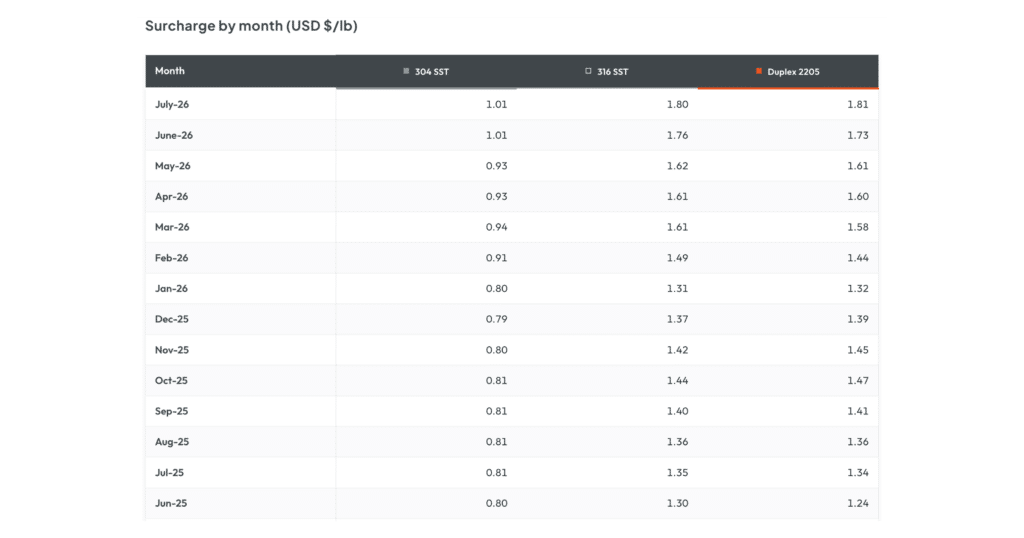
Material costs often represent one of the largest components of an industrial fabrication project. When projects involve significant quantities of stainless steel, even relatively small changes in surcharge values can influence the overall material budget. For shorter projects, monthly fluctuations may have only a limited impact. However, on larger infrastructure projects, long procurement schedules, or phased fabrication programs, understanding how surcharges move over time can help project teams plan purchases more strategically and improve budget accuracy.
This is one reason procurement teams often monitor stainless steel pricing throughout the year. Having visibility into monthly surcharge changes allows engineers and project managers to better anticipate market conditions, coordinate purchasing decisions, and reduce uncertainty when preparing project estimates.
“A stainless steel surcharge isn’t an extra fabrication charge. It’s a reflection of how global raw material markets influence the cost of stainless steel every month.”
Staying Informed Helps Projects Stay Predictable
While no one can predict exactly where commodity markets will move next, staying informed allows project teams to make more confident decisions. Understanding how surcharges work provides greater transparency during budgeting discussions and helps explain why stainless steel pricing may vary from one month to the next, even when the project scope remains unchanged.
At D&R Custom Steel, we believe informed customers make better project decisions. That’s why we publish our Monthly Stainless Steel Surcharge Chart, providing current surcharge information for commonly specified materials, including 304 stainless steel, 316 stainless steel, and Duplex 2205. Rather than asking customers to search multiple industry sources, we provide a single reference point that can support planning and procurement.
While fabrication quality, engineering, and project execution remain at the heart of what we do, sharing practical industry knowledge is equally important. Helping customers understand topics like stainless steel surcharges is part of building stronger partnerships, improving project planning, and supporting successful outcomes from quotation through final delivery.